
via Story Spun Yarns http://ift.tt/2dcsXVs


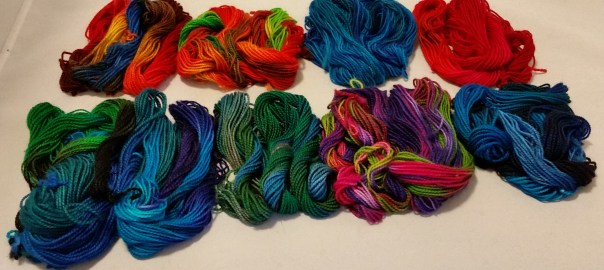
Last night, my husband, Bob, agreed to help nudge me out of my “all things tropical colors” rut. We pulled out all of the mixed dyes, plus a few powders. He picked colors randomly, and I had to figure out how to put them on the yarn in a visually appealing & dye friendly way. Below are some pics from our experiments. Iris garden is an old favorite that has been updated with a new set of greens.
The picture of lots of minis has a mix of my tropical blues & greens for comparison.
In other good news, I was able to recreate tiger lily! Sadly, I wasn’t able to get a good picture of the layered reds, oranges, pinks & browns. I’ll try again later when the light changes.
On a side note: Bob really likes orange. Given his preference, all yarns would have orange. Lots of orange. And possibly no other color than orange!
His birthday is coming, so I’m planning a yarn of all the different oranges. It should make a perfect “Don’t shoot me while I am hiking” hat.


Here is the yarn inspired by the Iron Druid Series. It’s not done yet. I’d like some copper colors in there, and perhaps tweak the blue. Getting close though!
I don’t know why I should be so happy that handpainting works well in a solar oven. Anything that works in a slow heat oven, should work in the solar oven. I was worried the slower cook time might lead to more color drift & muddy colors.
I presoaked the skeins in water at 3.5 pH. Then painted the skeins and let them sit for an hour. It was fairly damp/slightly drippy. I wrapped each skein in plastic, but I am going to skip this step next time. Instead, I’ll just cover the whole pan set up with a dark plastic bag to make a multilevel steamer.
After painting and wrapping, I put the first skein in a black covered pan, put a smaller pan with another painted skein on it on top. The pans fit so that there is a gap between the two. I covered the top pan with plastic and left the whole setup in the center of the oven to cook for 3 hours in afternoon sun. It was about 75F and mostly sunny.
More on this yarn as I work on the colors. I am also looking at making roving. The big question is what to call it. For now, I’m calling it Kevin’s yarn in my head. I promise I’ll have a proper name for it soon.
I’m working on a yarn inspired by the wonderful Iron Druid Series by Kevin Hearne.
https://www.facebook.com/authorkevin/
I’ll get to the yarn in a bit, but first the books!
The books are frequently categorized as Urban Fantasy- which they are. But they stand out from a genre that is being flooded by the Urban Fantasy Romance (which is ready for its own genre now!).
The central story focuses on Atticus, the last of the Druids, who is at a crossroads. Does he continue to hide from an angry god and live a diminished life under the radar, or does he confront the god, re-establish wider contact with others like him, and re-enter the non-mortal community?
For me, writing breaks down into characterization, plot, theme, voice, world building and word choice- in no particular order. In this case, the order doesn’t matter because Hearne hits every single one one.
Characterization: Kevin Hearne builds strong, interesting characters drawn from folklore & mythology. His take on mythology is fresh without ignoring the roots. That’s a big plus! He doesn’t assume that we are going to like his characters because they are the heroes & heroines. His characters earn the reader’s affection and sympathy.
Plot: How can anyone resist a tweak the nose of a god/ protect humanity plot line? more on this below. The story moves briskly with a nice balance of action and reflection. A strong collection of subplots build a strong world with good character interaction. The subplots come together to support a larger story line without making a muddle of the forward motion of the overall book.
The story doesn’t take itself too seriously. It’s fun without crossing the line into brain candy! Nothing wrong with brain candy, but who rereads those books? You will reread the Iron Druid books. And most likely will stalk the author’s page waiting for book updates with the rest of us Hearne fans!
Theme: Underlying the action is a continual theme of a do I step forth and *be*- or- do I take the familiar path? Do my past actions define me, or do I have the power & ability to do something differently?
World Building: Perfection! It’s seamless and believable without being tame or predictable. While reading, you know it is the only possible version of reality. Then you can step away from the book and realize he just pulled a rabbit, a dove and the Chrysler building out of that hat- & it totally worked!
Word choice: Hearne isn’t afraid of mixing a casual tone with a wide range of vocabulary. Reading his prose makes me happy!
Here’s the link to Kevin Hearne’s Good Reads page:
The story opens with Atticus, the last of the druids, living in hiding from an angry Celtic god, Aenghus Óg who wants to reclaim the enchanted sword stolen from him centuries before. The deity discovers Atticus pretending to be a 21 year old hippie running an occult bookshop in Arizona. With the help of a seductive goddess of death, his vampire and werewolf team of attorneys, a bartender possessed by a Hindu witch, a wolfhound and some good old-fashioned luck of the Irish – Atticus must prevent the god from gaining the sword’s power without unbalancing the detente between the different factions of Fae & Gods.
There are many perks to living for twenty-one centuries, and foremost among them is bearing witness to the rare birth of genius. It invariably goes like this: Someone shrugs off the weight of his cultural traditions, ignores the baleful stares of authority, and does something his countrymen think to be completely batshit insane. Of those, Galileo was my personal favorite. Van Gogh comes in second, but he really was batshit insane.
Thank the Goddess I don’t look like a guy who met Galileo—or who saw Shakespeare’s plays when they first debuted or rode with the hordes of Genghis Khan. When people ask how old I am, I just tell them twenty-one, and if they assume I mean years instead of decades or centuries, then that can’t be my fault, can it? I still get carded, in fact, which any senior citizen will tell you is immensely flattering.
The young-Irish-lad façade does not stand me in good stead when I’m trying to appear scholarly at my place of business—I run an occult bookshop with an apothecary’s counter squeezed in the corner—but it has one outstanding advantage. When I go to the grocery store, for example, and people see my curly red hair, fair skin, and long goatee, they suspect that I play soccer and drink lots of Guinness. If I’m going sleeveless and they see the tattoos all up and down my right arm, they assume I’m in a rock band and smoke lots of weed. It never enters their mind for a moment that I could be an ancient Druid—and that’s the main reason why I like this look. If I grew a white beard and got myself a pointy hat, oozed dignity and sagacity and glowed with beatitude, people might start to get the wrong—or the right—idea.
Sometimes I forget what I look like and I do something out of character, such as sing shepherd tunes in Aramaic while I’m waiting in line at Starbucks, but the nice bit about living in urban America is that people tend to either ignore eccentrics or move to the suburbs to escape them.
Next post is about the yarn 🙂
Until then, read Hounded!
 It started so simply. A few mason jars, filled with warm water, some dye and put out in the sun. Then I added a dark metal pan for the base. And stacked up some paving stones to make a wind shelter. And aluminum foil for a collector & solar oven v.1 was born.
When it was warm & sunny, the set up gave good results.
But when the wind picked up or the temps dropped, it didn’t. (sorry- no picture of the sad yarn. I threw more dye on it & put it on the stove right away)
Solar Oven v.2 was a black plastic storage bin, foil and a dry cleaner bag for a seal to trap the heat. The wind took it apart before it ever had a chance. Also, it seemed like the outside box was nice & hot, but the inside stayed cold. Not enough light collection into the center.
Which led to some websites on designs for solar ovens. I decided simple & durable were my main project guidelines. Cheap would be nice too 🙂
Here are the pics of Solar Oven v.3 in progress. It’s made out of basic pressure treated lumber & assembled using a circular saw, drill with bits & a screw driver attachment.

The lid is a simple piece of plexiglass that was precut to 30 x 36″ and supported by some 1 x 2 strips. It sits inside the box on rails to make a nice tight fit.

The day I got the wonderful idea to build a solar over, it was 68F and sunny. The day we started building, it was 41F & raining. Below are my not-approved for work gloves that I threw on when things got ridiculously cold!
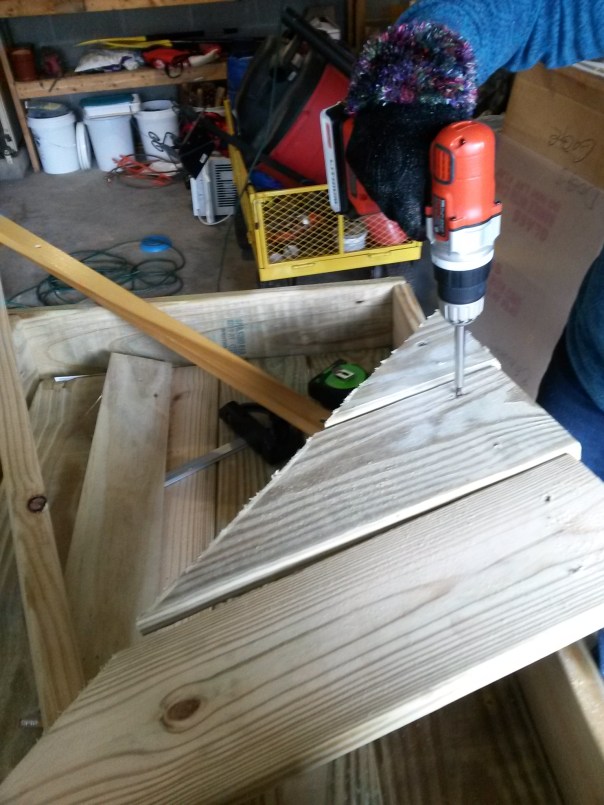
We’re ready for spray painting things black, but we need the temps to climb first.
There may be too much space inside the oven for it to heat well. If so, I’ve got the start of a wonderful garden box!
More updates shortly.
This is supposed to be a blog about stories as well as yarn, and I’ve been slacking on the book reviews and lists. So- ta-da! Here is the beginning of my “I love these authors” list. Why authors instead of titles? Because the people on this list are so good at what they do that I can’t pick just one title or even one series. I’ll start reviews by picking books/series from this list.
(yes- sci fi. The old fashioned abbreviation. I’m old, and I break out in hives when I see it written as SYFY)
Urban / Paranormal Fantasy
Before you say- wait- What about Benford, Bear, Gibson, Robinson, Scott Card, Modesitt, and all of the authors I love?! How could this list not include Tolkien! What about Asimov and Bradbury & Heinlein?! Alan Dean Foster, Robert Asprin, Piers Anthony.
Peace! I love these authors too. I’ve read most of their work. But for a bunch of capricious reasons. they aren’t on the list. Most people on the list are actively publishing. Not all. Some are important to me for personal reasons. It’s the joy of having my own list. And in case there is any doubt: Terry Pratchett will always be at the top any fantasy list I write.
This isn’t to say that more authors won’t be added along the way. Maybe I’ll add lists based on the publishing time period.


More handpainted garden yarn. Spring is dragging it’s feet around here, and I’m doing what I can to throw color around.
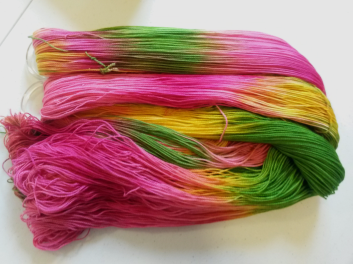
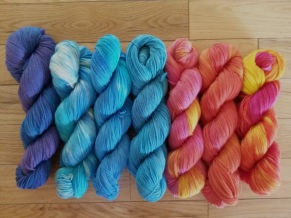
The two skeins above have the same four dyes blended in different ways. They look similar, but they will be quite different knitted up.
The top one has pink and green blending together which add a brown/earthy color to the yarn. The repeats are shorter- 2-6″ long- so that the colors will be more random in the finished piece.
The lower one has pink blending into yellow which adds a pink/orange color. The lower one has longer repeats that are dominated by the pink. This will be fabulous in a shawl because the long repeats will show as color lines rather than dots.

 On Saturday, I’ll be at the Fiber Frolic at Beaver Lake Nature Center, demonstrating spinning and doing a variety of things fiber-y for people’s entertainment.
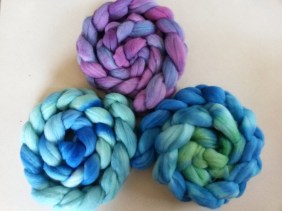
The Golden Fleece Spinners Society will have a story loom for public use. It’s lots of fun, so come and add a few rows. You can use these Leicester locks which I’m dyeing today to add some colorful texture.
Thanks to Heather at Lochan Mor Farms for donating fiber for demonstrations! 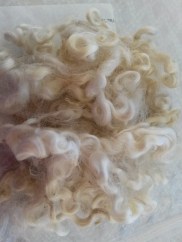
These are gorgeous locks. They are bright white with creamy tips and a firm structure. Dyeing multicolored locks is all about the wide bottomed pot and leaving the locks alone while the dye does its thing.
Directions:
Fill the bottom of your pot with a few inches of water and add citric acid. Pre-acidifying the water will make the color strike quickly. This means that some areas are going to take up more dye than others.
Put locks in and let them soak for at least 30 minutes.
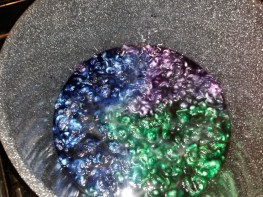
When you are ready to dye, add just enough water to keep the locks wet, not enough so that they are floating freely. Sprinkle dye powder in a few places and use a wooden skewer to gently spread the locks a bit and disperse the dye without sending it over into the other areas of the pot. You can also add concentrated liquid dye. I find the powder gives a better color variation.
Then, put in the temperature probe set to 180F, turn on medium heat and walk away until the probe beeps.
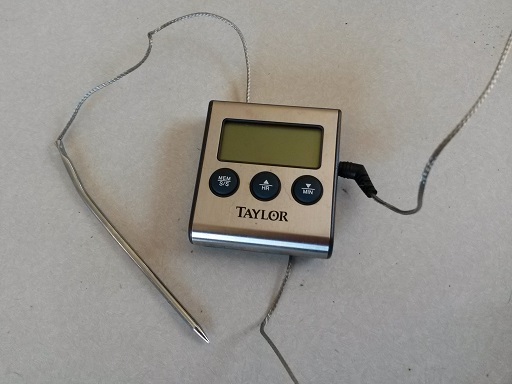
Here’s the spot in the process where I made a mistake. I was trying to do 27 things at once. I forgot to add the handy dandy temperature warning probe which is my solution to trying to multitask. The probe works by setting a goal temp- in this case 180F. The probe hangs out in the pot and when the temp reaches 180, the base starts beeping.
Lots of people dye without using the probe. You can just watch and wait until the pot almost comes to a boil and then turn down the heat. I know myself better than that.
Normally, the probe beeps, I catch the water before it boils, turn the heat down to low, and let the fiber sit in the hot, acidified water until
1) It reaches the color I would like,
2) the dye is exhausted & the water is clear or slightly milky, or
3) the fiber has absorbed all of the dye it is going to take.
It depends on the dye and the fiber, but that takes about 30-45 minutes- sometimes longer for a very saturated color. If the dye isn’t exhausting, you can try adding more citric acid. Or you may have used too much dye. *Or* it may need to cool down for the last of the dye to take.
Here’s the important part. After simmering, turn off the heat and walk away until the water cools to room temperature. If you need to reinforcement, set the temperature probe for 70 degrees and don’t touch until the probe give you permission.
Really. Don’t touch it. Every time you poke at it, you will start to open up the locks and either risk felting or ruin the lock structure.
Today, touching the cooling locks was not my problem. I forgot the probe but walked away waiting for the beep. This pot went to boil. Whoops! These locks are pretty resilient. It was tempting to start pulling on the fiber to see if it had felted. I was surprisingly good about it. I pulled the pot off the burner and walked away. (that’s unusual for me. I’m a prodder) Once it cooled, I was able to rinse thoroughly and get a rough idea of how things look.
 The saying is, “It isn’t felted until it is dry.” I’ll also add to that, “You don’t know the color until it dries.” In this case, everything still feels nice and loose. The colors are bright and have a nice variegated look. There may be some spots that are felted. Felting happens with heat and agitation. The boiling of the water was definitely adding agitation, so I’ll find out tomorrow if there are any sections that are locked up. If I start pulling on the locks today, I risk making any felting worse. So, it’s out in the sun with a kitty for company. The cat isn’t crazy about cold, wet wool in her sunbeam, but she’s agreed to share.
Most years, I love winter. I love curling up under a quilt with a dog or two in my lap. Wearing thick, cuddly sweaters while drinking hot cider. Coming in from snowshoeing and toasting my backside in front of the fire. I even like shoveling snow.
This winter has been awful. It’s been burn-your-face cold alternating with help, I’m trapped to the hip in salty slush-sand.
Yesterday, as it rained on the nice fresh snow again, my mood went from simple “let me play with the colors of nature to find Mary Oliver’s color” to “hey, I have an idea for a Latin American garden” to full-on gardenfest. Geranium pinks, hydrangea purples and blues, emerging bulb greens. If I can’t have fun snow, then I’m ready for Spring!

The garden skeins are fun and fairly simple to do. The greens were layered emerald green, kelly green and a bit of turquoise blended for variation. I laid turquoise blue, violet and pink stripes in between the green sections and let the colors bleed. I did some skeins with the color stripes reversing (green, purple, pink, purple, green) and some with repeats (green, blue, violet, pink, green). I didn’t have a pattern in mind for this, so I went for a shortish repeat that would make a nice color pattern on a basic sock.
I did get a little development work done. I don’t know where this one will end up. It’s quiet and soft without being muted. The base is a mill spun 80% merino/ 20% camel fingering yarn with a lovely natural camel-y color. I love working with tan bases because you just know up front it’s going to be an earthy skein.

I pressed the skein into a thin sheet and used a syringe and my fingers to paint a watercolor across the yarn canvas.
I did end up wrapping and steaming this one, but for these watercolor painted skeins, I should set up a steamer tray that will keep the canvas flat. In this case, the color mixing worked nicely. I used some ruby red which made a nice burgundy wine when blended. By the square inch, this is fairly balanced across the colors, but the turquoise definitely pulls everything together and stands out.
Even accounting for wet/dry color variation, I lost much more of the color than I was expecting. I was going for Marquez- Hundred Years of Solitude. Instead, it’s very English garden. Still, a good first step. I like the English garden look, so yea for that. Best of all, I have a much better idea of the colors and saturation required for the Marquez painting. Now I have to figure out how get it on the yarn!
 Story Spun Yarns